
Nebraska Mugshot Access Rules
Nebraska law does open some booking photos to the public. Statute §29-3520 is the key text. When a criminal-justice agency holds arrest-identification photos, they fall in a public category. Still, no rule compels an online gallery. A sheriff can keep a booking image yet leave it off the public roster. A court order or statute can close access later. Start with the official record and its custodian. Nothing in the law turns a private website into a certified source.
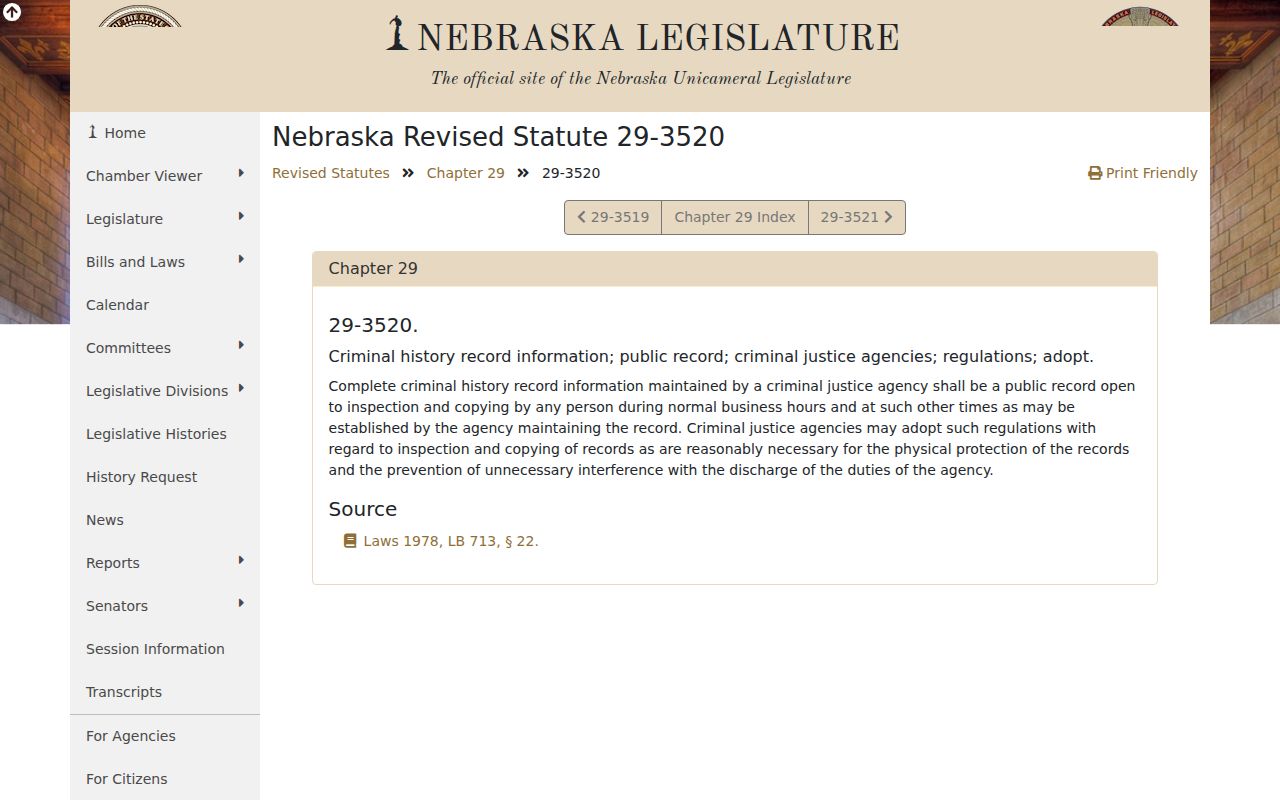
Nebraska Revised Statute §29-3520 sets the baseline. A complete criminal-history record held by a criminal-justice agency must stay open for inspection and copying. That access applies during normal business hours. Agencies may adopt reasonable rules to protect records and keep access orderly. The statute speaks to agency files, not websites. Under §84-712.01, a public record belongs to a state or political-subdivision agency. Another law must say otherwise. So a copy on a private site carries no agency certification just because the source image was once public.
The Legislature's §29-3520 page shows the criminal-history baseline in full. The law governs what custodians hold. Display choices stay with each office.
A booking photo records identification at the moment of arrest. That is its whole job. The rest of the case lives in other files, and the court record holds the outcome.
Nebraska Mugshot Law and History
Section 29-3521 spells out which records are public for dissemination. The list covers notices used to identify or apprehend fugitives and wanted persons. Photographs taken with an arrest for identification are on it. So are original police blotters plus offense and incident reports kept by criminal-justice agencies. Court records of judicial proceedings belong too. Department of Motor Vehicles traffic records round out the list. The statute sets an access rule for agency information. It does not order counties to run online mugshot galleries, follow a shared posting schedule, or treat a private copy as an official booking record.
The criminal-history provisions date to 1978. They arrived through Legislative Bill 713. Amendments since then have adjusted how records are handled after case outcomes. The annotations to §29-3521 and related sections track each change, including amendments through 2019. Old headlines age fast. For what an agency must disclose today, the current statute and its annotations beat an old news story.
Nebraska's statutes contain no dedicated anti-pay-to-remove mugshot rule. That gap is narrow. It does not bless every use of a booking image. Privacy, defamation, court-order, and records rules can still apply. The point is simple. Current criminal-history, public-record, sealing, and dissemination laws set no removal price for private sites and no duty to take a photo down for free. General doctrines still govern a publisher's conduct.
Two Nebraska Supreme Court decisions mark the limits of §29-3523. In State v. Coble (2018), the court accepted that making certain citation information nonpublic can affect a substantial right. Even so, the statute did not authorize the motion used in that case as a general route to nonpublic status. Doe v. State (2022) held that §29-3523 creates no private legal duty, so a private person cannot face tort liability for inaction under it. Neither ruling turns a web listing into a judgment. The Legislature's annotations to §29-3523 carry both citations.
Find Nebraska Mugshot Records
A missing picture settles nothing. An arrest record can still exist. The agency may have taken no identification photo, or the image may sit in another system. Maybe the roster just shows no photos. A lawful limit can also explain the gap. Ask the record holder for the public booking record and identification photograph. Give the name, incident date, and agency. If you meet a denial or redaction, ask which statute applies. Ask too whether a public portion can be released.
Nebraska's public-records law lets people inspect records during business hours and copy them, with actual costs and other limits set by law. The Attorney General's public-records outline explains the request and review process. A focused written request routes more easily than a broad demand for an entire investigative file. Name the booking or arrest-identification photo and the public booking record, not medical records, witness material, or the full investigative file. Precision helps.
- Name the agency that made the arrest or holds the booking file. If custody moved, ask which agency kept the original arrest record.
- Give the person’s full name, approximate incident date, and any known case or booking number. State that the request seeks the public booking record and arrest-identification photograph.
- Ask for the record in an available format and ask the custodian to identify the legal basis for any withheld part. A custodian may review, redact, or calculate lawful costs.
- If access is denied, review the written response and the administrative or court review routes described in the Attorney General’s public-records guidance. A denial by itself does not prove that no arrest took place.
Section 29-3524 allows criminal-justice agencies to charge reasonable actual costs for search, retrieval, storage, maintenance, and copying, subject to its fee terms and waiver authority. This is a government records-cost rule. It is separate from a private publisher’s correction policy and does not promise a free copy in every case.
Note: Public-records law does not guarantee release of investigative, juvenile, medical, or intelligence material that another statute allows a custodian to withhold.
When Nebraska Records Become Nonpublic
Nebraska records do not stay public forever. Section 29-3523 sets the clock. Once the statutory period or case event passes, the agency must respond as though the criminal-history record never existed. Statutory exceptions still apply. The trigger depends on the outcome. If no prosecutor files charges, one rule applies. The arrest, citation, or referral record goes nonpublic after one year. Charges skipped because the person finished diversion stretch that to two years.
Other outcomes close access right away. A prosecutor can dismiss by motion. Acquittal or a not-guilty finding counts too. So does a completed deferred judgment, drug court, or problem-solving court. Access ends once the required notice goes out or the dismissal order is entered. A sealing order can reach information about arrest, custody, charging, trial, and hearing. Adjudication, supervision, dismissal, disposition, and sentence count as well. Notice then goes to the state and local agencies the statute names.
The exact event matters. A dropped charge and a court dismissal are different legal things. So are diversion success, an acquittal, and a sealing order. Keep the paperwork that shows which one happened. A current search result can lag behind the law. An old copy may also sit in a private database. So the agency's public record and a private copy can disagree.
The official text of §29-3523 spells out the no-charge, diversion, dismissal, and other outcome rules. Read the statutory wording plus any notice or court entry that fits the individual case.
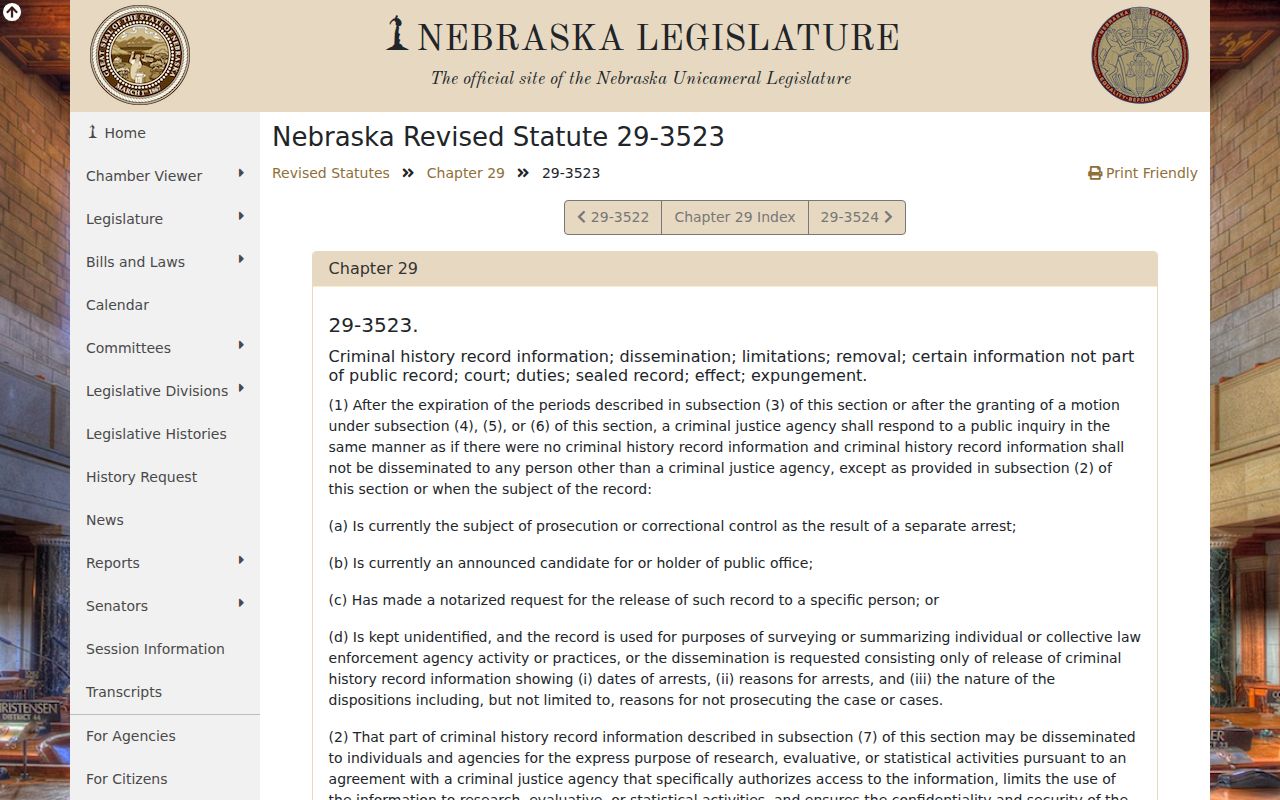
The statute page is a legal reference. It does not check case status. To confirm a trigger was met, look at the person's court file or the agency's response.
Nebraska Juvenile Mugshot Limits
Juvenile records take a different path. Section 43-2,108.01 covers people under eighteen. It reaches cases with no petition filed or with qualifying diversion or mediation completed. Section 43-2,108.05 authorizes sealing and tightens access. Only the young person and others named by law may see it. That includes specified law-enforcement, court, and legal officials. A juvenile case is therefore not an adult public booking record.
The Judicial Branch says sealing is usually automatic for listed outcomes. No charge, dismissal, and successful diversion or mediation all qualify. So do restorative justice, successful probation or treatment, or a completed juvenile sentence. What if the record was never sealed automatically? The subject, a parent, or a guardian can ask. The wait lasts until the person is an adult, or six months after case closure. A court then reviews rehabilitation. The court supplies a juvenile motion process and form. A child's old image in a third-party result does not make it public.
The Judicial Branch's juvenile sealing page lays out both the automatic and motion-based paths. Everything hinges on case type and outcome.
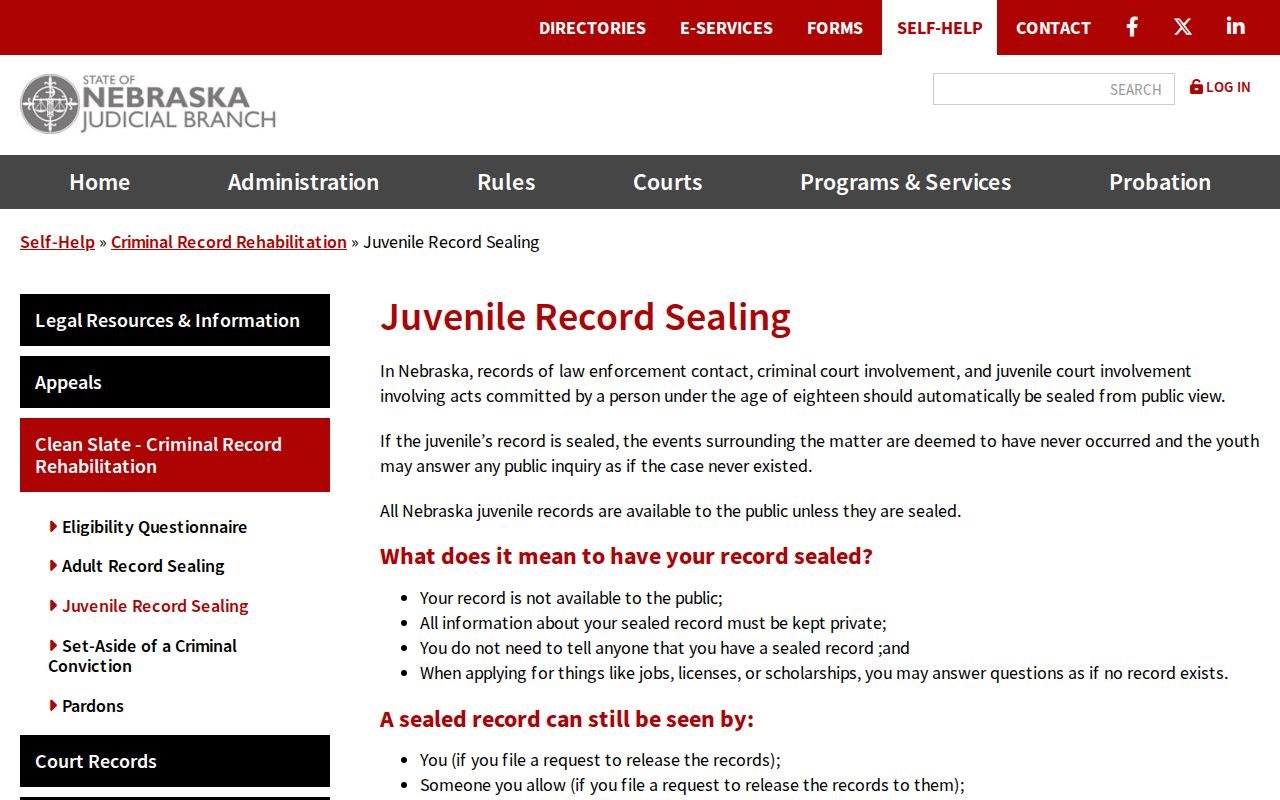
The court's page offers sealing guidance only. It is not a juvenile record search. Case-specific questions belong with the juvenile court or a lawyer who can weigh the facts.
Nebraska Adult Sealing and Photos
For adults, the Nebraska Judicial Branch calls sealing the main public-access remedy. Nebraska keeps records public unless a court seals them. A sealed record is closed to the public, though criminal-justice agencies may still reach it for uses the law allows. Sealing does not erase every photo.
Dismissal, acquittal, and not-guilty findings head the list. Cases dismissed or ending in acquittal after December 31, 2016 are usually sealed automatically under the statutory framework. Older cases may need a motion. Survivors who win a set-aside under §29-3005 for sex trafficking can seek sealing. So can someone who receives a pardon. Separately, Section 29-3523 handles no-charge, diversion, dismissal, deferred-judgment, acquittal, and problem-solving-court outcomes.
"Expungement" in Nebraska means something narrow. The law-enforcement-error route in §29-3523(9) is one example. It will not wipe every conviction or every copy held outside government. A set-aside, pardon, juvenile seal, adult seal, and expungement each carry different legal effects. Skip the label in a search result. Check the court order or statute that actually applies.
The Judicial Branch's adult-sealing page describes who qualifies. It also warns that sealing does not automatically change privately held websites or databases. Read it before asking an agency to update a public record.
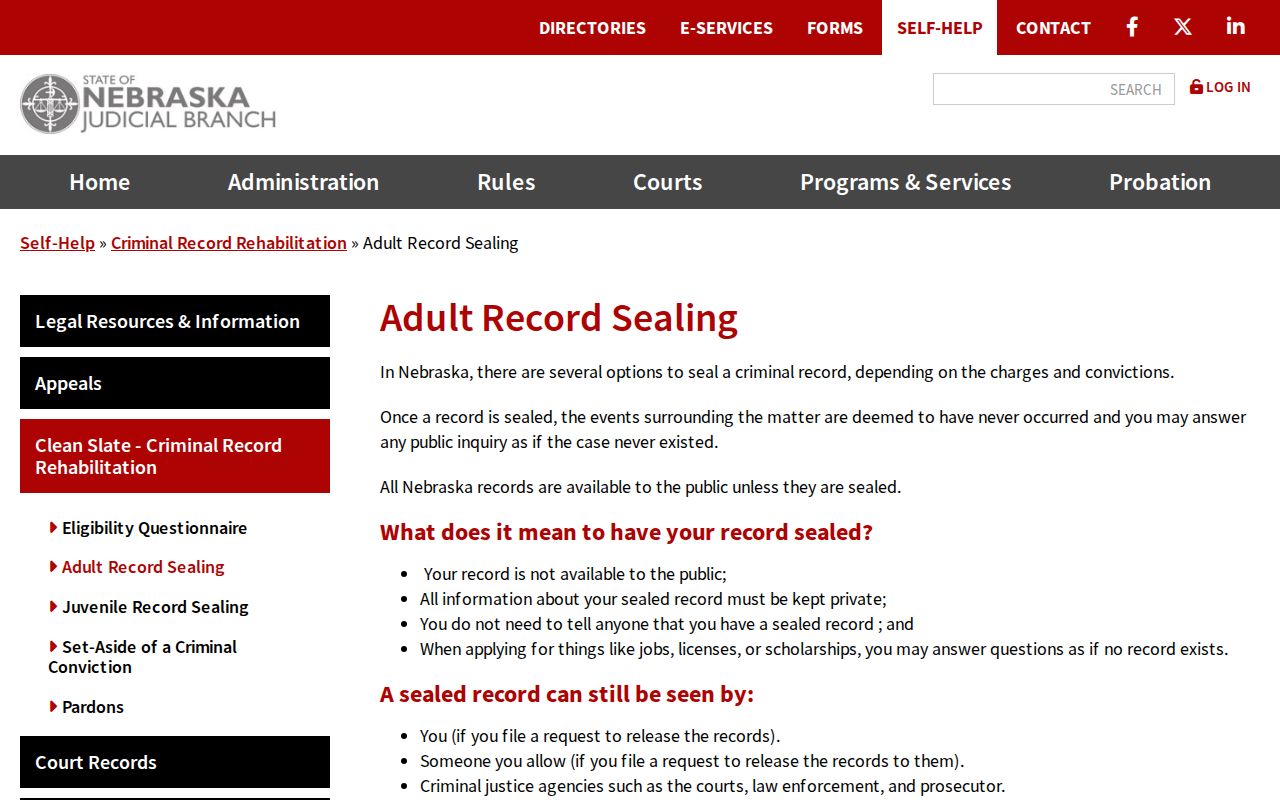
The court's page is an eligibility overview. It cannot tell you whether one person qualifies. Work through the applicable court process, and keep a copy of any order or notice the court issues. Note: Match any order or qualifying outcome against the custodian's current entry before relying on an older copy.
Official Records and Private Copies
Start at the source record. Confirm the correct person, the case number, and the final outcome with the court or agency that holds the file. Sealing or correcting a record changes the agency copy first. When a statute or court order marks a record nonpublic, that status governs the official version. It does not erase copies already held elsewhere. The Judicial Branch says sealing does not automatically strip a record from privately maintained websites or databases. That leaves work for the person affected. Proof of the case outcome may have to go to each publisher holding its own copy. Ask the originating agency first. It can apply the new legal status to its public display. For a wrong or outdated copy, follow the publisher's published policy. Send the page URL. Add clear supporting documents. A mugshot page is a secondary record, so it can lag behind the court file, sit incomplete, or tie to an outdated charge. It may be stale. One search result disappearing proves nothing about the official record either way.
Free Nebraska Mugshot Corrections
Removal policies differ from site to site. Several secondary publishers offer free correction paths for qualifying records. Each one sets its own rules. Busted Newspaper's removal policy asks for a name, contact details, and the post URL. It also wants legal proof of a qualifying result like dismissal, acquittal, sealing, or expungement. Its stated review window runs about five to ten days. It lists no charge for a qualifying request. Approval is never promised.
RecentlyBooked's policy also charges nothing for requests that meet its criteria. Qualifying details matter here. Those criteria cover a sealed or dismissed case or wrong or outdated details. They also cover the wrong person, a juvenile record, or a duplicate. Submit the record URL, identifying details, and the reason. Include legal documents when they matter. The policy lists info@recentlybooked.com as a contact route. Mugshots.com's record-maintenance policy likewise treats qualifying update or removal requests as free. Court documents and identity checks may be required. It allows up to ten business days, with no guarantee of a result.
Free is not automatic. A contact form alone tells you nothing about cost, timing, or approval. Read the current instructions before mailing documents. And a fix at one site leaves other copies alone.
Search engines add one more wrinkle. An old snippet can linger after the source page changes. Google's outdated-content removal tool targets that stale result. It will not seal an agency record or force another publisher's hand. Keep the source page and the search listing separate when you ask for a correction.
These materials are not from a consumer reporting agency. They are not for any purpose covered by the Fair Credit Reporting Act.
Choose the Right Nebraska Record
Custody decides where to look. A county roster shows current custody, sometimes just a short release window. It may omit the photo. It may drop a person right after release. Booking records come from the arresting or holding agency instead. Court files settle charges and outcomes. If the person reached state prison, the Nebraska Department of Correctional Services (NDCS) holds the record, not the county jail.
For a fresh county arrest, the Nebraska statewide mugshot and booking records page gathers the official rosters and request routes. For a prison profile and photo rules, use the NDCS offender-search resource. Those systems answer different questions. A private archive tells you neither where someone is now nor whether a case is open.
If the photo is missing, ask whether it exists. If it is present, check its date and source. Then confirm the court disposition. One name can sit in three different files. Note: A county booking file, a court docket, and an NDCS profile answer different questions even under one shared name.