
Historic Nebraska Mugshots
Notoriety never changes where a record lives. A booking photograph exists for identification. A court file, by contrast, holds the charge, the motions, the verdict, and the sentence. Separate offices may keep those materials apart. A face beside an old headline tells you nothing. It reveals nothing about what a judge or jury decided.
The six entries below rest on court opinions, official litigation records, or agency material. Anyone can check it. Each one names a disposition and a path to the right record. No photograph appears here. When no original booking image is online, the agency or archive in charge of it is the place to ask. That request works within public-record rules and any exemption that applies.
Nebraska Notable Case Records
This table is a route map, not a ranking. Every outcome listed comes from a court opinion or an official state report. One case can be split across several hands, too. The arresting agency, trial court, appellate court, and archive may each hold a different piece. Those pieces make up the record.
| Case and year | Documented outcome | Record route |
|---|---|---|
| Charles Starkweather, 1958 | Conviction and death sentence; executed in 1959. | Nebraska Supreme Court opinion; Lancaster County court file; History Nebraska collections. |
| John Joubert, 1983 | Two first-degree murder convictions and death sentences; executed in 1996. | Nebraska Supreme Court opinions; original local-agency and Sarpy/Douglas-area records. |
| Nikko Jenkins, 2013 | First-degree murder and related convictions, with death sentences and consecutive terms described in the court materials. | Nebraska Supreme Court opinions; Omaha Police/Douglas County records. |
| Anthony Garcia, 2013 / 2016 | Charged in 2013; a jury found him guilty of all charges in October 2016. | Douglas County court file; Nebraska Commission on Public Advocacy report; Omaha/Douglas arrest record. |
| Bailey Boswell, 2017 / 2020 | Convicted in 2020 and sentenced to life in prison in 2021. | Saline/Dawson County court records; Nebraska Attorney General release; originating agencies. |
| Aubrey Trail, 2017 / 2019 | Convicted in 2019 and sentenced to death on June 9, 2021. | Saline County case; Commission on Public Advocacy report; arresting agency. |
A single name can surface in many places. It may appear in a press story, a booking log, a trial file, and appellate opinions all at once. Check dates and counties before you link them. A case summary is only a starting point. For a final outcome, the court's written decision or docket beats everything else.
Note: A verdict, an appellate opinion, and a later sentence entry may answer different questions, so cite the court document that supports the stated outcome.
Starkweather Photo and Record
Charles Starkweather was arrested in the 1958 Nebraska homicide case. The case grew into one of the state's largest criminal proceedings. The conviction and death sentence trace to the Nebraska Supreme Court's certified opinion in Starkweather v. State. He was executed in 1959, per historical material. The court record settles the disposition.
The criminal case ties to Lancaster County and Lincoln-area agencies. For a historic identification photograph, start with History Nebraska's Historic Nebraska Mugshots collection along with its RG2418 photo collection list. Ask the archive to identify the item first. A web image is not the original until the archive says so. That distinction is the whole lesson of this route. It sits between a court opinion and an archival photograph.
Joubert Court and Photo
John Joubert's Nebraska case carried two first-degree murder convictions. The prosecution and appellate history appear in the Nebraska Supreme Court's 1986 State v. Joubert opinion. The convictions and death sentences were litigated on appeal. Joubert was executed in 1996.
Original arrest and booking material sits with the local agencies behind the Bellevue/Sarpy County and Omaha-area investigation, while the appellate decisions stay in the court record. A historic prison image, if one survives, would come through the records custodian or the State Archives and History Nebraska's RG2418 finding aid. Here is the trap. A later prison photo and the original arrest image are not interchangeable records.
Jenkins Case Record
Nikko Jenkins was arrested and prosecuted in Douglas County after the 2013 Omaha-area killings. Nebraska's court library holds a certified State v. Jenkins opinion. The court materials describe first-degree murder convictions plus related firearm and prohibited-person offenses. Death sentences and long consecutive terms followed. The opinion and judgment form the disposition trail, and the arrest account alone does not.
The original booking record and any arrest photograph belong to the Omaha Police Department and the Douglas County criminal-justice records system. Both sit subject to public-record rules and investigative exceptions. The public court opinion reaches the legal result. It is not a source for a current booking photograph. Anyone after an original image should identify the arresting custodian and request that specific record.
Garcia Case Record
Anthony Garcia was charged in Douglas County in 2013. The charges were four counts of first-degree murder and four weapon counts. The Nebraska Commission on Public Advocacy's annual report states a jury found him guilty of all charges. The verdict came in October 2016. It also describes aggravating-circumstance litigation and death-penalty representation. That jury verdict is the outcome to carry forward when you check the arrest record.
The Douglas County district-court file is the trial record. Appellate and capital-case materials may sit with the Nebraska courts and the Commission's reports. The original booking photograph is a separate Omaha/Douglas law-enforcement record. A photo copied into a news story needs a date and a true source attribution. It should never pass as a current roster image.
Boswell Case Records
Bailey Boswell was arrested in 2017. The Sydney Loofe case later moved to Dawson County for trial. The Public Advocacy report lists a 2020 conviction. A three-judge panel then imposed a life sentence. The November 8, 2021 sentencing release from the Nebraska Attorney General confirms that detail.
The paper trail runs through the Saline and Dawson County files. Investigators on the case included Lincoln Police, the FBI, the Nebraska State Patrol, the Saline County Sheriff, the county attorney, and the Attorney General's Criminal Bureau. Some investigation material may be withheld. That includes photographs, under §84-712.05(5). Ask the originating agency for the booking image, and treat any news copy as a secondary source, since a public booking record and an investigative photograph are not the same item.
Trail Case Records
Aubrey Trail was Boswell's co-defendant. He was tried first in the Loofe case. A Saline County jury convicted him in 2019. On June 9, 2021, a three-judge panel sentenced him to death. The Commission on Public Advocacy report records those outcomes. It also describes two other felony offenses and the court's death-penalty procedure. Any mention of the arrest belongs beside that full record.
The original case sits in the Saline County court file, while the state litigation report maps the disposition route. Investigative photographs and interviews may fall under public-record exceptions. Ask the arresting agency or county custodian for the booking photo, and keep it separate from a later state-prison locator result, which shows current custody rather than the original booking.
Find Nebraska Arrest Records
Those case routes point to a practical method for checking any unfamiliar name. Start with the event and the agency. Then move to the court disposition. Old records sometimes moved to an archive. Ask about that when the file seems missing. The statewide Nebraska booking and arrest-record overview explains how to find current county-level sources, and the same agency-first approach works for older cases.
For court records, the Nebraska Judicial Branch case-information page is the official entry point for statewide trial-case searches. It is a court-record tool, not a photo gallery or live jail roster.
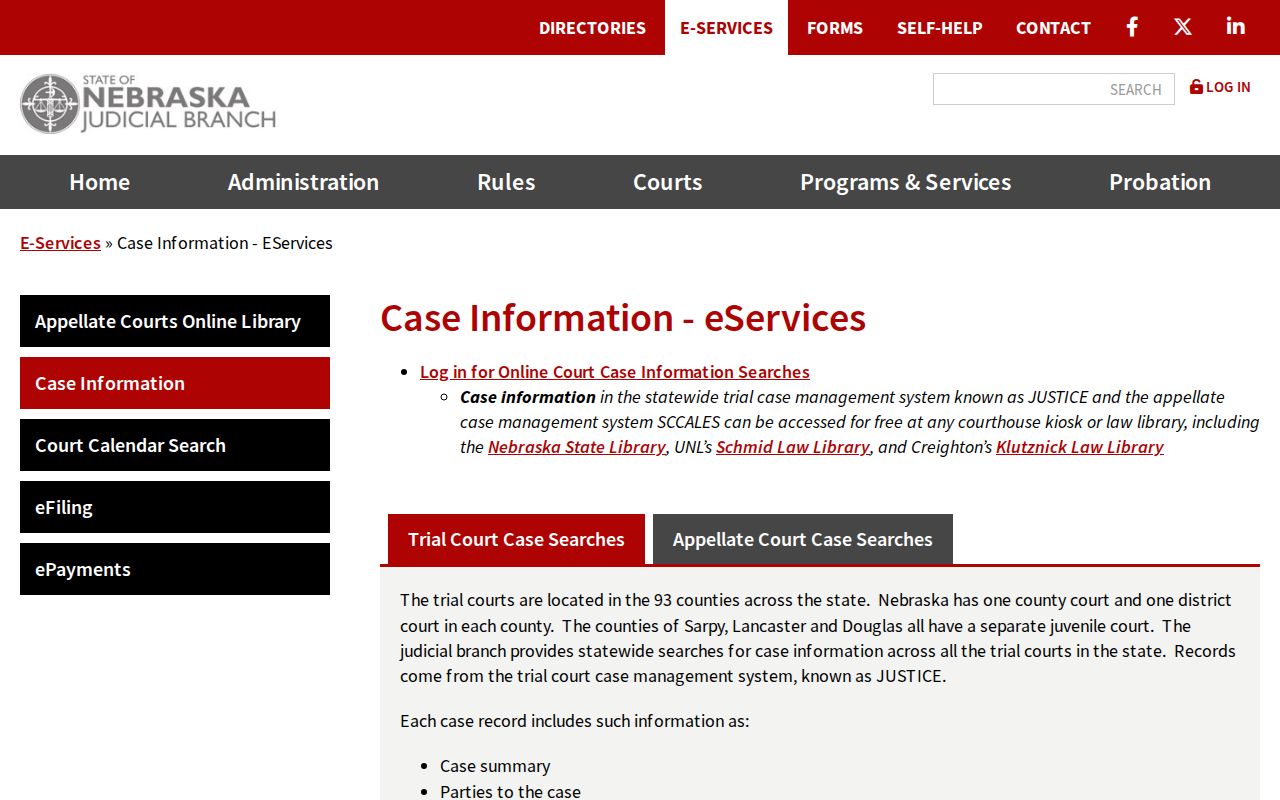
The screen shows where a court search begins. It does not display an arrest image or settle anyone's current custody status.
- Write down the known county, agency, approximate date, and case number if one appears in a reliable source.
- Use the arresting agency’s current public roster or records-request route for the booking record and identification photo. Ask for the public booking item, not an entire investigative file.
- Use the Nebraska Judicial Branch’s case-information service to locate a trial case and its register of actions. For eligible detail, the JUSTICE one-time name search may return up to 30 cases, can lag a new filing by about a day, and, as described in the September 2026 research, costs $17 even if it returns no case and provides three days of access. Confirm current terms before using it.
- Read the court entry or opinion for the result. A filed charge, dismissed count, acquittal, deferred judgment, or conviction each describes a different outcome.
- For a historic photo, search the archive finding aid and request the named collection item. A search result may be an index entry rather than a digitized image.
The statewide trial-case service covers all 93 counties. It is not a live booking feed, a warrant search, or a photo source. What it can show is a case summary, parties, offense details, and a register of actions. A register of actions lists the filings and case events. Document images appear when available. New cases take about 24 hours to show up. One-time name searches cap at 30 results. Those limits matter when a search returns nothing.
A case can also drop from public view because Nebraska law limits release after certain outcomes. An exception can withhold information too. A missing result says nothing by itself. Ask the court or agency about the record and the reason for any restriction.
For older photographs, History Nebraska's collections include state-prison and Omaha Police Court materials. County sheriff records can carry long retention periods, though a county website may display records for a much shorter window than the schedule allows.
Note: A retention period governs agency records, while a website display window may close sooner or follow its own update policy.
Historic Nebraska Archive Records
History Nebraska says state-penitentiary photography began in 1867 and describes collections with state-prison and Omaha Police Court photographs. Its RG2418 photo collection list is a finding aid, not a promise that every negative or print is online. An archival index may help locate a file, but a search hit is not necessarily a digitized image.
For older county sheriff records, the Schedule 15 retention rules help identify whether a file may still be with the agency, transferred, or past its retention period. Adult files that include mug shots have a 50-year felony period and a 25-year misdemeanor period, with a shorter rule in specified circumstances when the same record is kept elsewhere. Jail registers have a 25-year period after the last entry or may be transferred to microfilm, subject to State Archives review. These are retention rules, not the length of time a county website keeps a page online.
Begin with the Mugshot Archives route when searching older material. Use the archive’s finding aids to note a record-group number, series, county, prisoner number, or date. Contact History Nebraska’s Research and Reference Services to ask whether the item is digitized, whether a staff search or reproduction is available, and what conditions apply. The research room uses appointments, so check its current instructions before planning a visit.
If the item remains with a county or NDCS, request it from that agency and ask whether the original was transferred. An old photograph may be a prison image rather than the county booking image. A finding aid can point to a box, roll, or collection without showing the image itself, and access can be limited by law, court order, donor terms, or preservation needs.
Nebraska Photo Record Limits
The Legislature's §29-3520 text sets a public baseline for complete criminal-history information held by a criminal-justice agency. The statute covers access to agency records. It never requires online booking photos. It also does not make a private copy an official record.
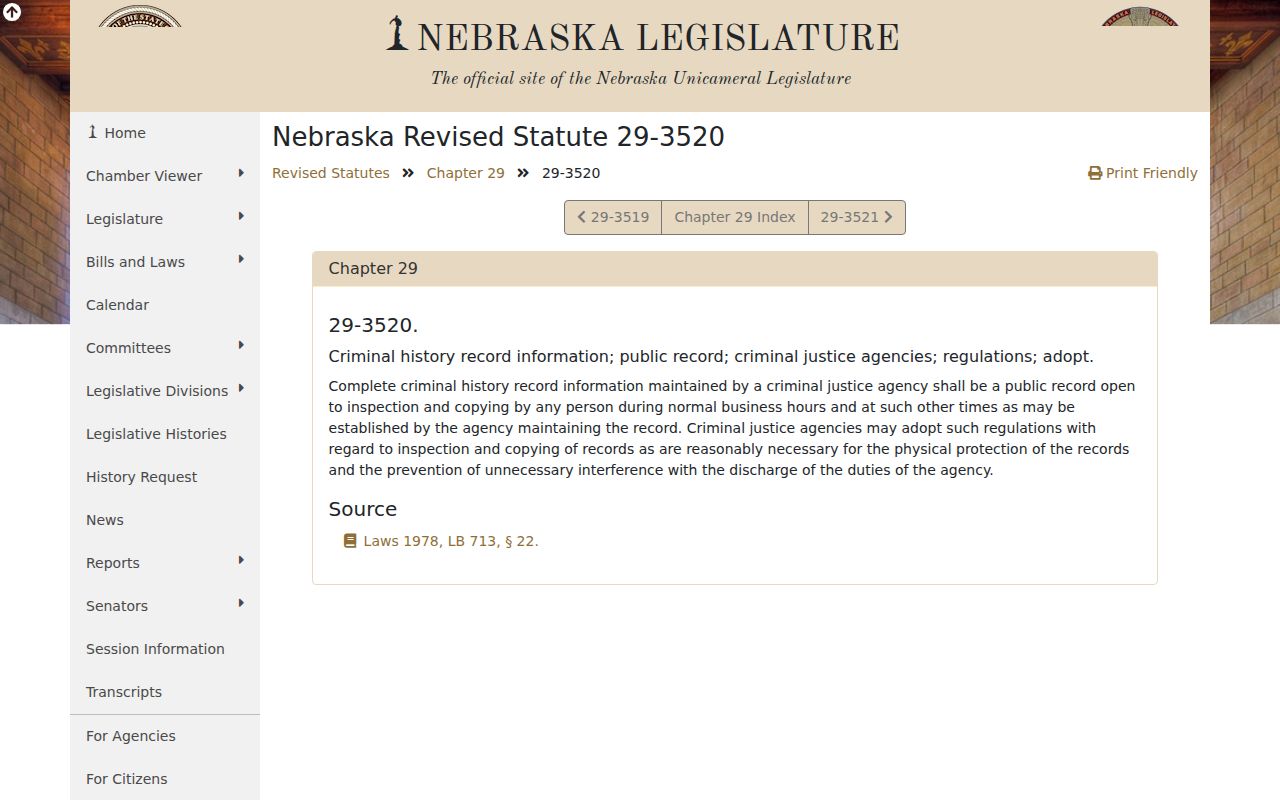
The Legislature's page prints the statute's public-record language. No mugshot appears there. Section 29-3521 names arrest-identification photographs and wanted notices as public categories an agency may release. Exceptions still shield some records. Investigative and intelligence files, juvenile information, and medical material can be withheld. A good request names the arresting agency, the person, and the approximate date. Ask for the public booking record and the identification photo. Outcome-based limits live in §29-3523. No-charge, diversion, dismissal, or acquittal can change what an agency may release. The Legislature's text is the direct source.
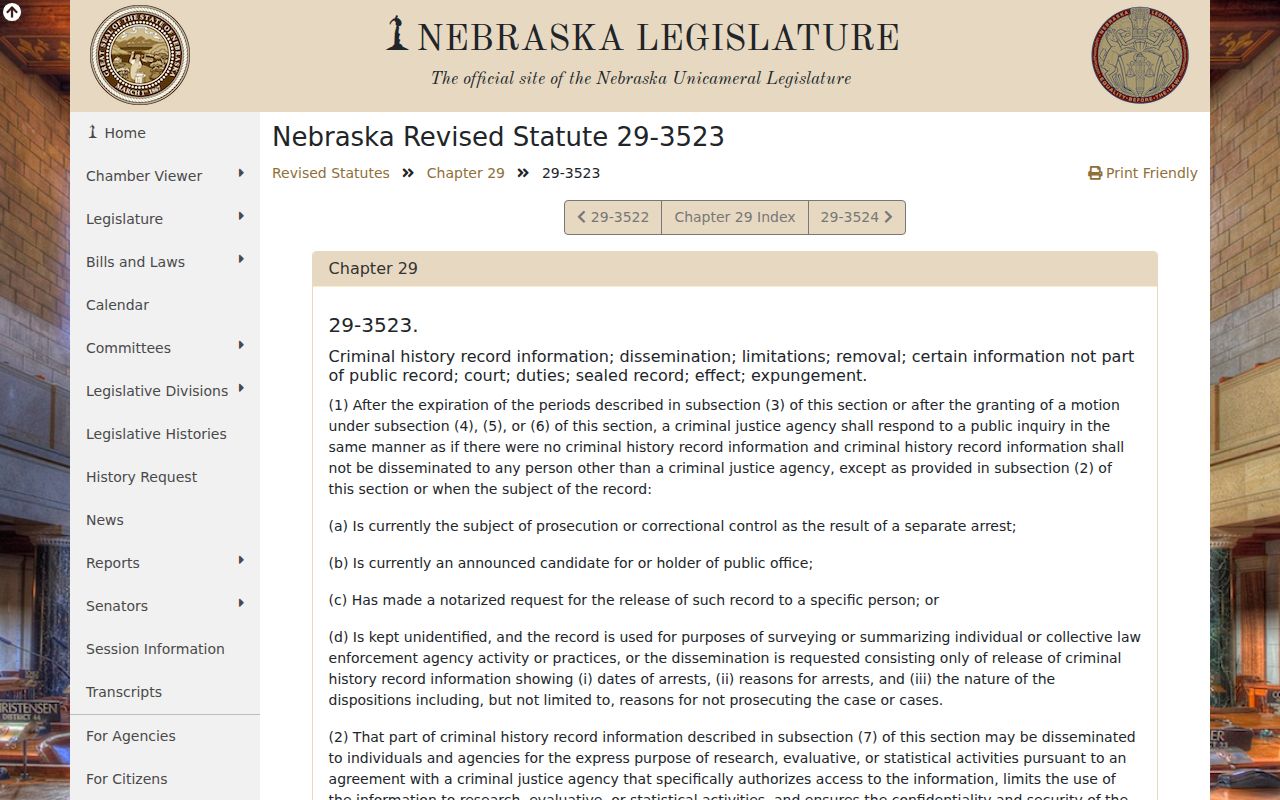
Court outcomes matter to agency records. State v. Coble (2018) explains that §29-3523 does not authorize that particular general motion as a route to make records nonpublic. Doe v. State (2022) held that the law alone did not make a private person legally liable for failing to act. Neither case changes what the statute itself says.
Investigative photos can stay restricted. A booking record may still be public. Ask the custodian about the item itself. Ask about the review route too. A private database can keep a copy long after the official system drops it. Report the court disposition when you ask.