
NDCS Mugshots and State Custody
The Nebraska Department of Correctional Services runs the state's prisons and offers an Incarceration Record Search for the public. The name tells you the scope. This is a state corrections system. It will not stand in for a county jail roster, list every Nebraska arrest, or tell you whether someone has an open warrant. County sheriffs and city police handle the records for people held before trial. An NDCS entry appears once a person is serving a state sentence or otherwise shows up in the department's incarceration records.
Here is a common trap. The arresting county, the holding county, and the county of commitment can all differ. Commitment refers to the county tied to the state sentence, not the arrest location. A move into NDCS custody changes the best search route, yet it never converts the state profile into the original county booking record. The two records can carry different photographs, dates, case references, and update schedules. A county booking photo documents an intake event. An NDCS photograph is an agency identification image tied to a corrections record, and the two are not interchangeable.
Nebraska law spells out how criminal-history information becomes public. Section 29-3520 covers public criminal-history record information. Section 29-3521 places arrest-identification photographs among the categories open for public sharing. Section 29-3523 then limits public sharing after specified outcomes. None of this guarantees that a given record or photo will surface in the locator itself.
Important: A disposition is the court's final outcome, such as dismissal, acquittal, deferred resolution, or conviction.
Search the NDCS Locator
Use the official NDCS form when the question involves state corrections custody. A last name or a DCS identification number gets the search started. The first name stays optional. Know what the DCS ID is. It is a department identifier. It is not a county booking number, not a court case number, and not a federal register number. The locator requires a reCAPTCHA check before returning results. A broad surname can pull up more than one person. Read the result details closely before calling a match correct.
- Open the official NDCS Incarceration Record Search and check that the address ends in ne.gov.
- Enter a last name, or use a known DCS ID. Add a first name if it helps narrow a name search.
- For a DCS ID, enter the numeric department number. The form allows up to seven characters; do not paste a county or court number into that field.
- Complete the reCAPTCHA and submit the form. Compare the displayed name and ID with the information already known.
- Open a result and read its status, sentence or commitment information, and county of commitment. If no photo appears, do not assume the record is missing.
The form also connects to an official Download All resource. Think of it as a data access option. It is not a county arrest feed. It is not a photo gallery. Check the resource's own date and status information before using any row to describe current custody. A surname-only match can mislead, especially with common names or multiple cases. The department ID and commitment details are what separate one person from another.
The NDCS search form puts the name fields, DCS ID, CAPTCHA, submit controls, and download link together. It all sits on one official page.
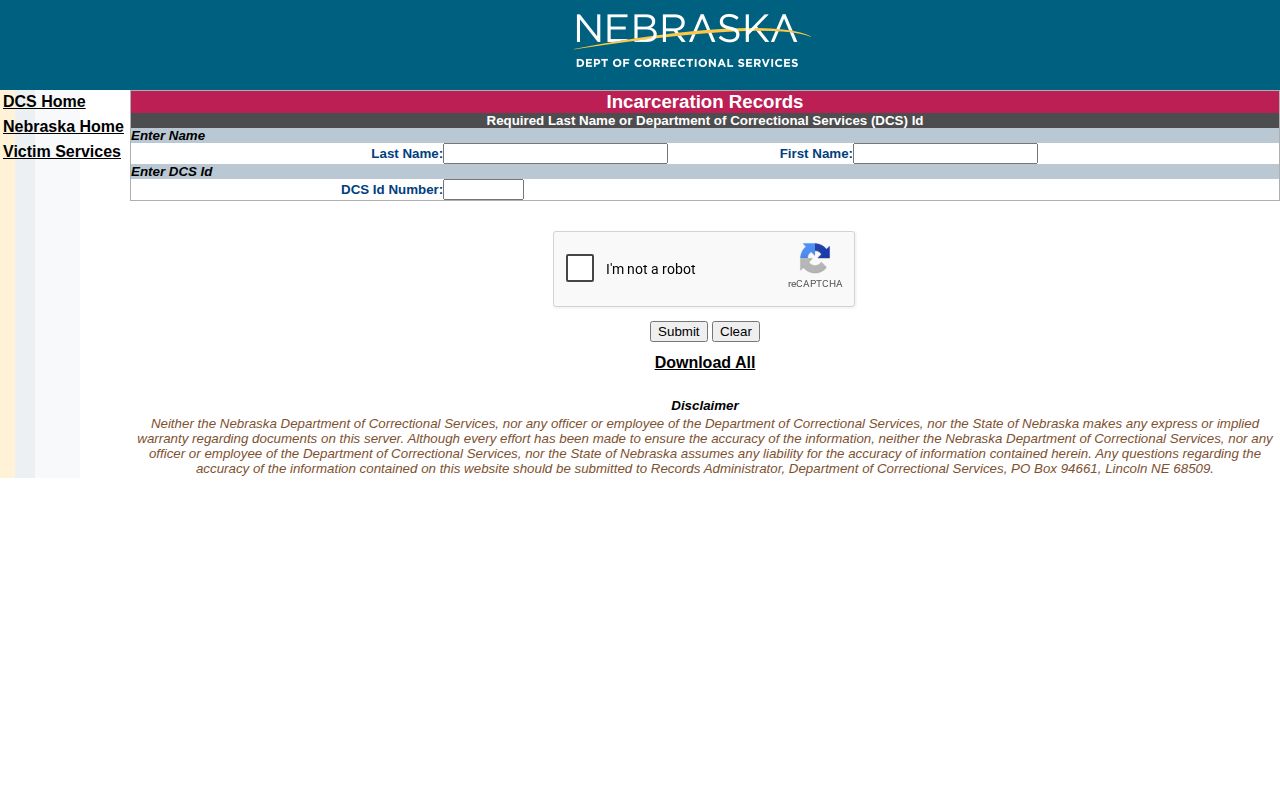
The visible form is just a lookup entry point. It does not promise a photograph or every profile field with each result.
NDCS Incarceration Record Fields
NDCS Policy 002.01, Access to Public Information, took effect March 31, 2025. It lists categories that may be public. The list runs broader than the live profile. It names identifying, custody, sentence, and photo information. The interface may show only part of it for any one record. Read each field as agency-maintained information rather than a court judgment.
| Information category | What it can show | How to read it |
|---|---|---|
| Name and number | Person’s name and NDCS identification number | Use the DCS ID to distinguish people with similar names. |
| Identity details | Age or date of birth | Confirm identity carefully; do not rely on a name alone. |
| Custody | Facility and length of stay | A location reflects the corrections record, not the original arrest location. |
| Offense and commitment | Crimes committed and county of commitment | Use the court file to confirm the charge and its final outcome. |
| Sentence and release planning | Parole eligibility, tentative release date, or parole-hearing date | These are record fields and dates, not a promise of release on a particular day. |
| Official photograph | NDCS photographic identification of the incarcerated person’s face | The policy names this public category, but a photo may not render in each search result. |
Some fields can be missing, limited, or unclear without the rest of the record. A projected date is not a release event. Parole eligibility is not a grant of parole. When a result has changed, rely on the current status and ask NDCS for a dated record if the exact value matters. Never fill gaps by copying a photo or a claim from an unofficial page.
NDCS Photo Policy and Limits
The 2025 policy labels an official photograph of an incarcerated person's face as public information. That label matters. It puts the image in a category the department may disclose. It does not promise a face beside every search result. NDCS posts no rule setting a photo-refresh interval for its locator. Nor does it say a transfer triggers a new public image. Some results simply lack a photo. The omission can mean several things. The locator may not display it, the record may sit in another system, or the shot may not be open to the public on that screen.
The same policy walls off sensitive file material. Excluded items include medical and mental-health records. Also excluded: intelligence and internal-investigation files, psychological and counselor records, and admission summaries. Material prepared before sentencing stays protected, as do classification records, prior criminal history, progress notes, discipline, and parole plans. Parole is supervised release that state rules may allow. Asking for a face photograph is a narrow request. Asking for a whole inmate file is not. Naming the public-information category and the relevant date keeps the request clear.
No schedule governs when the public search updates a photo. So an NDCS mugshot should never be called current just because it shows online. The locator guarantees no image for every result. When the date or version matters, ask NDCS which image it holds in the public-information record. A county booking shot often lands closer to the arrest date. The NDCS image serves corrections identification instead. The two can differ and still both be true.
NDCS Photos vs County Bookings
Match the source to the question. Was the person just arrested, or held before trial? Then the arresting city or county agency holds the booking record. For a Nebraska state-prison commitment, the NDCS locator is the tool. One person can pass through both systems. Each public view may carry a different photo date. The County Directory routes to local county pages, which point to each county's official roster or records contact.
| Record | Custody or event covered | Best next step |
|---|---|---|
| County booking record | Arrest intake, pretrial custody, or a county jail stay | Start with the arresting or holding county’s official roster, then ask that agency for the booking record or photo. |
| NDCS incarceration record | State corrections custody and commitment information | Search by last name or DCS ID, read status and commitment fields, and request an NDCS photo if the locator omits it. |
| Court case record | Charges, filings, hearings, and final disposition | Use JUSTICE or the relevant court record to confirm what happened after arrest. |
A county roster can drop someone after release or transfer. The booking record itself stays with the agency. That disappearance does not mean NDCS took custody. The reverse holds too. An NDCS profile can show a state sentence while saying nothing about where the arrest happened or how the county booking image looked. Work each stage through its own system, and confirm results with the custodian that created them.
For a county-level arrest, the Nebraska County Directory leads to the right local records route. A state-prison question goes back to NDCS. The court disposition answers the case result. Keeping those three apart prevents a county arrest, a prison commitment, and a final court outcome from blending into one record.
Former Offender Search Results
The NDCS tool is labeled an Incarceration Record Search. The label is not a rule. Nothing on the form says only current inmates appear. Nothing guarantees that released people stay searchable with a photo. A linked Download All page offers another official data interface, yet it does not settle how long a released person's profile stays public. Read the status and dates on the specific result. Never call someone currently imprisoned off an old page, a kept image, or a name match.
Former custody has a second route. History Nebraska's prisoner-records database description documents historical prisoner material and an index spanning broad periods. An archival entry is not a live custody result. An old image proves no current sentence or location. Present-tense questions start with the current NDCS record. Ask the department when an entry is missing or unclear. Historical research belongs with the archive's own description and request process.
Keep three questions apart: active NDCS custody, a locator result that lingers, and a photograph surviving in an archive. The same person can get three different answers.
Request an NDCS Prison Photo
When the online profile has no photo, go to NDCS's written public-records process. The department tells you to check existing resources first. Then give contact information. State that the request runs under Nebraska's Public Records Statutes or section 84-712. Describe the record and its date range. Ask for the public portion only. Phrase it as official NDCS photographic identification of the face, with the person's name, DCS ID if known, and the incarceration or discharge period. A booking or court case number helps. It cannot replace the DCS ID. A record custodian is simply the office or staffer who handles the request.
- Check the locator and Download All resource for the public information already available.
- Write a specific request with your contact information, the person’s name, any known DCS ID, the record type, and a useful date range.
- Ask for the public face photograph or another named public record, rather than an unrestricted institutional file.
- Email the request to DCS.PublicRecords@nebraska.gov or mail it to Public Disclosure Unit, Nebraska Department of Correctional Services, P.O. Box 94661, Lincoln, NE 68509.
- Review the department’s response about access, lawful cost, delay, or any withheld portion. Narrow or prioritize the request if NDCS offers that option.
The NDCS request page shows the agency's submission route.
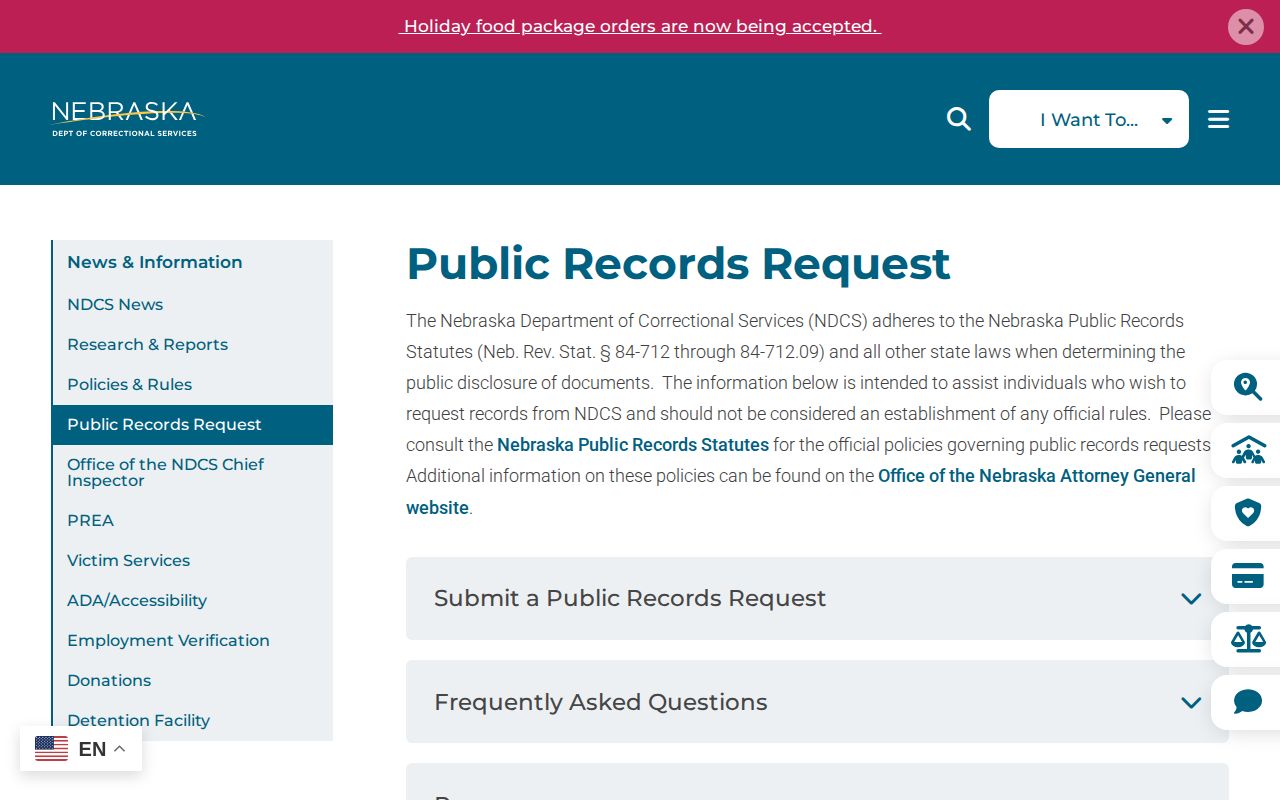
Start with the official request page. It carries the current mailing instructions, and agencies do revise those steps from time to time. Read it before anything goes in the mail.
NDCS promises a reply within four business days. A reply is not the same as delivery of the record itself. Complex requests, or ones that might carry a fee, get a written explanation from the department. It will estimate the completion date and cost, and it will offer a chance to modify or prioritize what you asked for.
Submitting the request costs nothing. Producing records can still bring approved actual costs. When only part of a file can be released, request the public portion and have the custodian cite the basis for withholding the rest.
NDCS Records and Exceptions
Nebraska's public-records law lets any interested person examine public records. You can take notes or copies during business hours. Section 84-712 spells out copies, formats, online access, and actual costs. The law defines public records broadly. Physical form does not matter. Separate statutes can pull specific information out of public view anyway.
NDCS points requesters toward protected categories. Incarcerated-person files fall in that group, along with medical and mental-health records, intelligence or internal-investigation material, and execution-team identities. County agencies can face the same limits. An arrest-identification photo may be public. Investigative or medical details around it may not be.
So name the booking or identification photograph in the request. Asking for a whole investigative file invites redaction work. A custodian can review the file and cover exempt material before release. The law-enforcement exception in section 84-712.05 reaches investigative and intelligence records. It also reaches complaints, informant information, and strategic or tactical material, subject to its own terms. A withheld part proves nothing about whether an arrest happened. A missing image might simply mean the online interface does not display it.
A denial is not the end. Section 84-712.03 offers administrative and court review routes. Ask the custodian to state the legal basis for any denial or redaction. Save the written response. Narrow requests travel better than broad ones. A public photo and booking record are easier to assess than an entire institutional file. Public still means reviewed before release.
NDCS Photo Retention and Archives
Keeping a photo and publishing it are separate matters. The Nebraska Secretary of State's Schedule 92 for Correctional Services, item 092-037, covers the adult central file. It includes inmate photographs and fingerprint cards. The file splits three years after release from incarceration or parole. Photographs made before 2001 go to scanning and then the State Archives. Digital images after 2001 stay on the mainframe permanently under the schedule.
Those rules govern the agency's own retention. They say nothing about the public locator. A retained image need not appear in current search results. An archive photo may sit outside the online system entirely. Old pictures can require an archive search or a written request. Specify the date range and image type. "The mugshot" alone does not say what you mean. It could be county intake, an NDCS identification photo, or an older archival image.
The same logic applies to empty searches. A photo can be retained yet unpublished. It may have been transferred, or access may hinge on a custodian's review. One blank screen is not evidence that the image was destroyed. Nor is it proof that the person was never in NDCS custody.
NDCS Status and Court Outcomes
An NDCS profile answers one narrow question: who is in corrections custody right now. It says nothing about how a court case ended. For that, the Nebraska Judicial Branch case-information page is the place to go. Its statewide trial-case search covers all 93 counties. The JUSTICE system behind it can display a case summary. It also lists the parties and offense details. Financial items and judge notes are included, along with a register of actions. Document images appear too, where the court makes them available. Those fields tie a custody entry to its underlying proceeding. They are not a booking feed, though, and they hold no mugshots.
The one-time JUSTICE name search comes with limits worth knowing. A brand-new case may take about 24 hours to show up. A name search returns up to 30 cases. It costs $17 even when it finds nothing, and access lasts three days. General list searches may be free. Case detail can still carry a fee. Eligible document images generally start with records after April 16, 2008. Check the current service page before ordering.
Matching the right case takes more than a name. Use the county, the date, and the case number together. The register of actions is the key document. It shows each final event: a dismissal, an acquittal, a deferred outcome, or a conviction. Quote the disposition and its date when describing a case. Custody status can linger after sentencing begins. It never tells the full court story alone.